
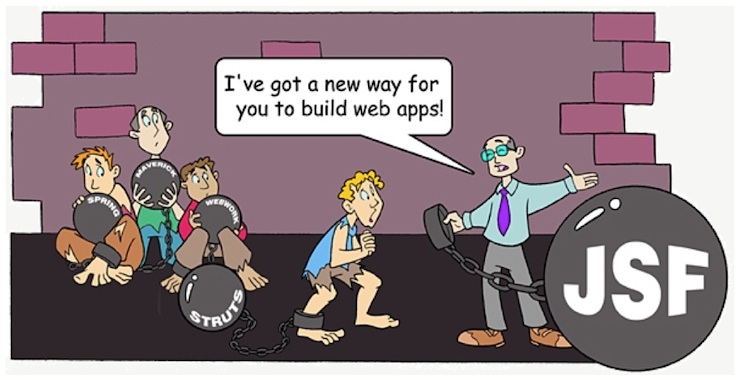
When it comes to developing web applications using Java, writing all the code from scratch has its advantages if you’re trying to master a new technology, but for real life web applications, you have to go for a framework as many expert developers would agree. Otherwise you risk a great deal of failure because of having allocated too much time and too many resources by re-inventing the wheels. There are some hardliners who still argue why …

JBoss Dev Studio (also known as RedHat Developer Studio) is a branded version of a Eclipse packed with the right version of JBoss Tools. The dev studio is usually bundled with a developer subscription from RedHat for $99. (I’ve been told, however, by Max Rydahl Andersen a JBoss employee who was also one of the developers of JBoss tools and the developer studio that the JBoss Developer Studio IDE itself is actually free without the JBoss commercial runtimes – i.e. JBoss EAP).
If you stick with Eclipse IDE with the JBoss tools plugin, I came up with the following matrix of the set of tools showing the coupling of compatible versions.
In Hibernate a derived property (also called a calculated property) is a read-only property whose value is calculated at fetch time using SQL expressions. Example: For an employee entity with properties such as an id and the employee name also a monthlySalary property, you might also want to have a yearlySalary which is not necessarily stored in the database. package net.ozar.exp.entity; import javax.persistence.Column; import javax.persistence.Entity; import javax.persistence.Id; import javax.persistence.Table; @Entity @Table(name=”EMPLOYEE”) public class Employee implements …


